






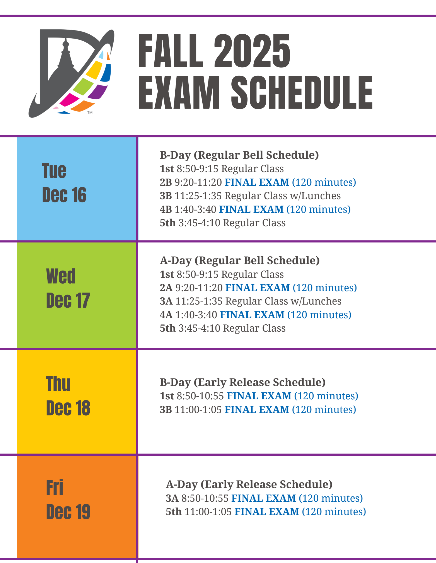
Finals at Guyer are fast approaching, which often causes students to go into a panic about studying abundant materials on such a short deadline.
You can use these tips as you go about studying to build your confidence during exams and calm your stressed nerves.
Tip #1: Plan out your study sessions
Before you jump into a panicked review, do some planning, as its absence probably got you into this situation in the first place.
Organize what topics you will be studying day by day. This should include reviewing each subject the night before their respective tests. Also, anticipate which tests will be harder and need more time to review than others, so that you can account for that in your schedule. For example, if you have a hard math final coming up, plan which units you are covering which night. Write this down somewhere, like a planner or to-do list. If you have an easy test you know you’ll do well on, still review the material the night before to get your brain in the right place, but don’t let it take up much of your limited time.
Tip #2: Prioritize
Prioritization is essential when you’re short on time. Don’t avoid studying for a hard test by studying for an easy one, and do what must be done first. If your teacher provided a review that is required to be completed, make that your first mode of studying. If you’re getting practice questions wrong repeatedly, go back and look over your notes before continuing.
Quality over quantity applies here; effective studying is better than staying up until 2 a.m., sleepy and unfocused.
Tip #3: Setting and materials
Before you actually start to cram your brain with a semester’s worth of information, make sure your study setting is the best for your needs.
Your setting is crucial to your focus. Find somewhere with no distractions, where you feel comfortable, and where you know you can do everything you need.
Put on noise-canceling headphones, have a “study with me” video playing in the background, put your phone in another room, and light a candle to stimulate brain activity. Try to sit somewhere your back won’t be aching after a while, and where you can write comfortably.
From the moment you sit down, make sure that you have all of your materials with you, including an outlet and charger in case of a dead battery.
You might want a friend around, too, so that you can study together and encourage each other. Jerome Noel, who teaches Honors Geometry and BC Calculus, suggests trying a study group.
“I know two people in particular that study really well together. They often come in here during lunch, sit down, off in their own little world, and they’ll just ask each other questions, helping each other out, studying together,” said Noel. “And, it’s always good to study with someone who maybe knows a little bit more than you, otherwise it is the blind leading the blind.”
Tip #4: What to study
Considering that you have everything planned, you’re settled in a distraction-free location, and you possibly invited a friend to explain topics where needed, it is time to decide what to study first.
Now, unless your teacher has explicitly said that their review is exactly what will be on the final exam, don’t exclusively study the review they provided. Going over old notes may refresh your memory a bit, but it doesn’t reinforce the knowledge in any way, and completing the review will only get you some of the way there.
“You definitely need to look back at past quizzes, tests, your old reviews, some old homework that you have completed,” said Noel.
Following the schedule you hopefully wrote out for yourself, determine if the class you’re studying for is more memorization- or understanding-based.
If the tests you have had in the subject prior require mostly memorization of the notes or study guide, make a flashcard set full of every term that was on the test review, notes, and/or tests. This could even include practice questions. Do this on paper, Quizlet, or, for a free, unlimited alternative, Knowt. Making the flashcard set could be a bit time-consuming, and it’s okay if there are a lot of cards, but getting someone to help you make and study them would be beneficial on a tight schedule.
If the class is more about understanding and applying the material, the best thing to do to budget your time is to go over the main concepts of each topic and do practice questions.
To do this, you could skim notes and summarize them in your own words. Rewriting notes by hand (or making flashcards by hand) makes the material more memorable, since it requires you to be more engaged with the task at hand.
“Then I would search up practice questions on Google. There will be websites and flashcards for you to use,” said sophomore Jason Wang. As an A student in all honors/AP classes, Wang is a test-taker to look up to. “And, if there isn’t, you can use the study guide your teacher gives you. Put it into ChatGPT and ask it to write you some practice questions.”
TIP #5: Reinforce your weak points
Going over your weakest skills is a great place to start when studying at the last minute. This will ensure that your level increases during your study sessions and that you have a lower chance of getting those questions wrong on the exam.
If you don’t know them already, a way to discover your weak areas is to write out everything you can remember from each unit or topic—explain how to work through a problem, causes and effects, definitions, timelines, anything—and then compare that to notes or summaries to see what you missed. You can also look over past graded work and see which questions you got wrong, making sure you understand why you missed the question and can answer a similar one now. Practicing the questions you got wrong will particularly help you fill the gaps in your knowledge.
Tip #6 – Making sure you’re understanding what you’re studying
A way to deepen your understanding and connect concepts to one another is to draw out a mind map. Write out all of your key review concepts, maybe add a few details underneath, and scatter them around a page. Then, draw arrows to the ones that have similarities or differences and that you can make some connection between. This reaps two benefits at once; writing the concepts down acts as a review, and making connections between them deepens your understanding.
Tip #7: Maximizing your time
There are other strategies you can practice to get the most out of your time, such as taking a small break every once in a while will preserve your mental endurance.
Look away from the screen and give your eyes a break, and reduce the risk of a headache. Walk around a bit to stretch your legs and refresh your mind. Watch a little bit of a show to keep yourself positive. It’s okay to break the focus every once in a while, as long as you come back ready to focus once again.
Tip #8: Feel good and make the information last
Here is something to be strict about with yourself: Don’t stay up studying all night before the exam.
First of all, you don’t want to fall asleep while you’re taking the test. Secondly, Rapid Eye Movement (REM) sleep is extremely beneficial for understanding and retaining information. REM sleep forms connections between concepts, and Non-REM sleep pushes things into the long-term memory part of the brain.
To go through the full REM cycle, it is suggested that teenagers get 8-10 hours of sleep, so this would mean going to sleep between 9 p.m. and 11 p.m. if you have to be at Guyer by 8:50 for first period. Also, take into account how long it takes you to fall asleep, because falling asleep doesn’t progress the REM cycle.
Tip #9: The day of
Right before the exam, it is best to get your mind in the realm of the subject.
“On the day of the test, I would just quickly go over my notes,” said Wang. “And, if I got any questions wrong on the practice questions, I would also go over them.”
Tip #10: Mindset
Finally, if you feel you still aren’t prepared for the exam, try not to get into a defeated headspace. Instead, tell yourself that you are confident when you sit down to take it.
Telling yourself you can’t do it will undermine the abilities you do have and cause you to doubt yourself and your answers. Instead, think of positive affirmations, relax your body and straighten your posture, and set a pace of completing questions that is quick yet accommodating to your system. Confidence, even when faked, will reduce the doubt and possibly earn you a few extra points.
Now, with these tips in mind, get to studying and pass your exams!