






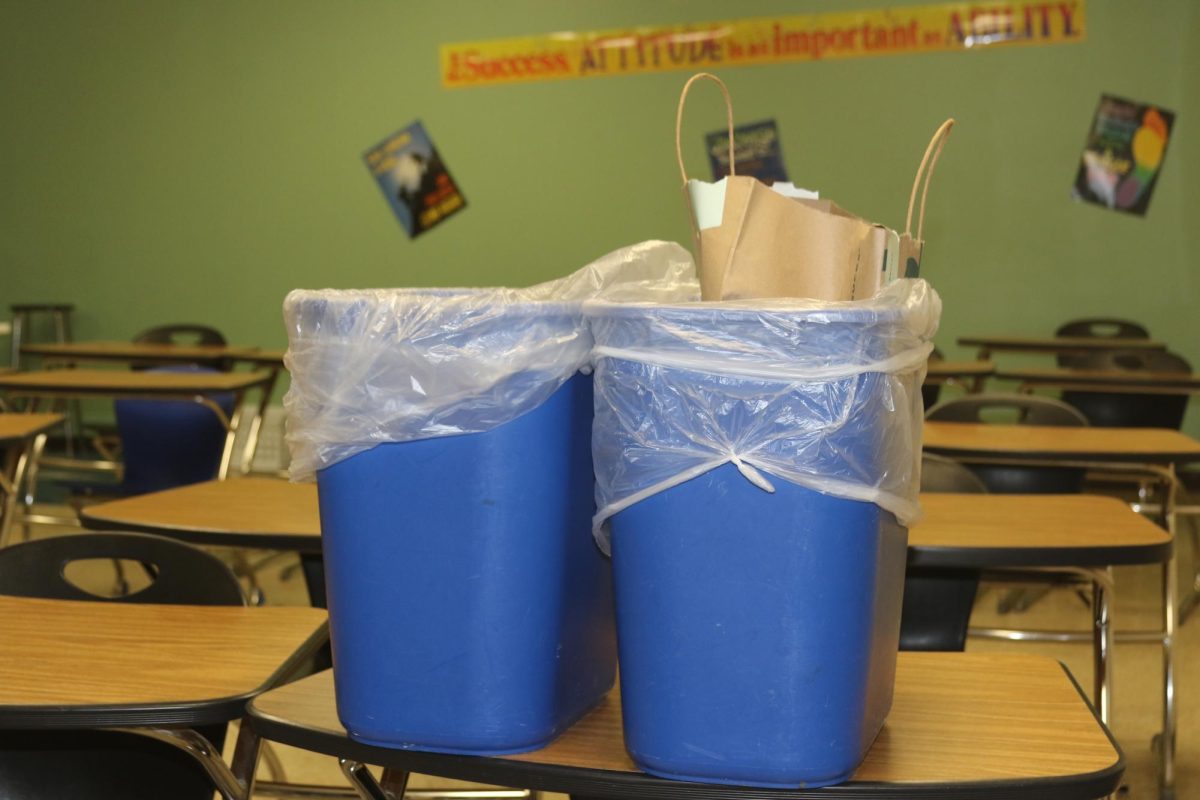
Even with blue recycling bins lining nearly every hallway, Guyer is quietly sending much of its “recyclables” straight to the trash. This disconnect raises questions about whether the school’s sustainability efforts are more of an appearance than a reality.
Across Denton, recycling contamination has become a growing problem, with many facilities rejecting batches of recyclables if too much trash is mixed in. According to environmental agencies, even small amounts of contamination can send recyclable materials straight to landfills, which increases waste and costs for communities. Guyer has been very behind on recycling; many people don’t know how to recycle properly, and haven’t made it a daily habit to recycle, causing it to be difficult for the landfills in Denton. The landfills have been constantly contaminated with all the recycling items and trash getting mixed with each other.
In the past few months, several people have questioned whether the school’s recycling system is functioning properly. While the recycling bins are visible everywhere, the process appears to be inconsistent, raising concerns about how strictly recycling efforts are enforced in our school.
The issue may seem like a big thing, but it’s actually something that can be easily fixed, according to staff, which is confusion about which bin the items really go in.
“Both teachers and students do not know what should go into the recycling bin, and because it’s not monitored, there’s a lot of contamination,” AP Environmental Science and Honors Chemistry teacher Stephanie Riley said.
When the trash and recycling items get all mixed on their way to the landfill, it causes contamination. There is a specific number to which the contamination can rise, and if it exceeds that limit, the school is charged for it.
“It’s more of a penalty; if it’s not recycled correctly, then the school is charged money,” Riley said.
Previous attempts at recycling, however, were met with challenges and controversy.
“Five years ago, there was a time when StuCo had been collecting recycling, but then when we were required to lock our doors, there ended up being some tensions between teachers and people coming into recycling, [which created] some backlash towards StuCo, so then they decided to end the program,” Riley said.
StuCo, APES, and Green Team have done many things after that to make our school greener and help with recycling.
“[For some of] Green Team’s meetings, we would pick up recycling, but it wasn’t every week, though. It was maybe once a month or once every few months,” Riley said.
Many administrators didn’t even know that this issue is occurring currently at our school.
“I didn’t know that [we weren’t recycling properly],’’ Freshman principal Consonya Owens said. “[but] I’m in a position where I should, and I can increase awareness.”
The decision to stop recycling may seem minor, but it has a bigger impact than many realize, affecting both the planet and the future we leave behind.
“There’s purpose and value when we separate [the bins] appropriately that benefits our earth, benefits the ability to reuse and remake products, so no, we’re hurting ourselves,” Owens said.
The question that arises now is whether there’s anything that can be done to improve recycling at our school, but some students are skeptical.
“I dislike seeing recycling bins even used,” Riley said. “I think that they should be completely removed from all the classrooms, and all of the large bins should be given back to the city of Denton, because they are not recycling.”
Despite challenges, some students and teachers continue to push for change. With every effort to recycle, reduce, and reuse, the school moves closer to a culture of sustainability, showing that even small actions can make a difference.